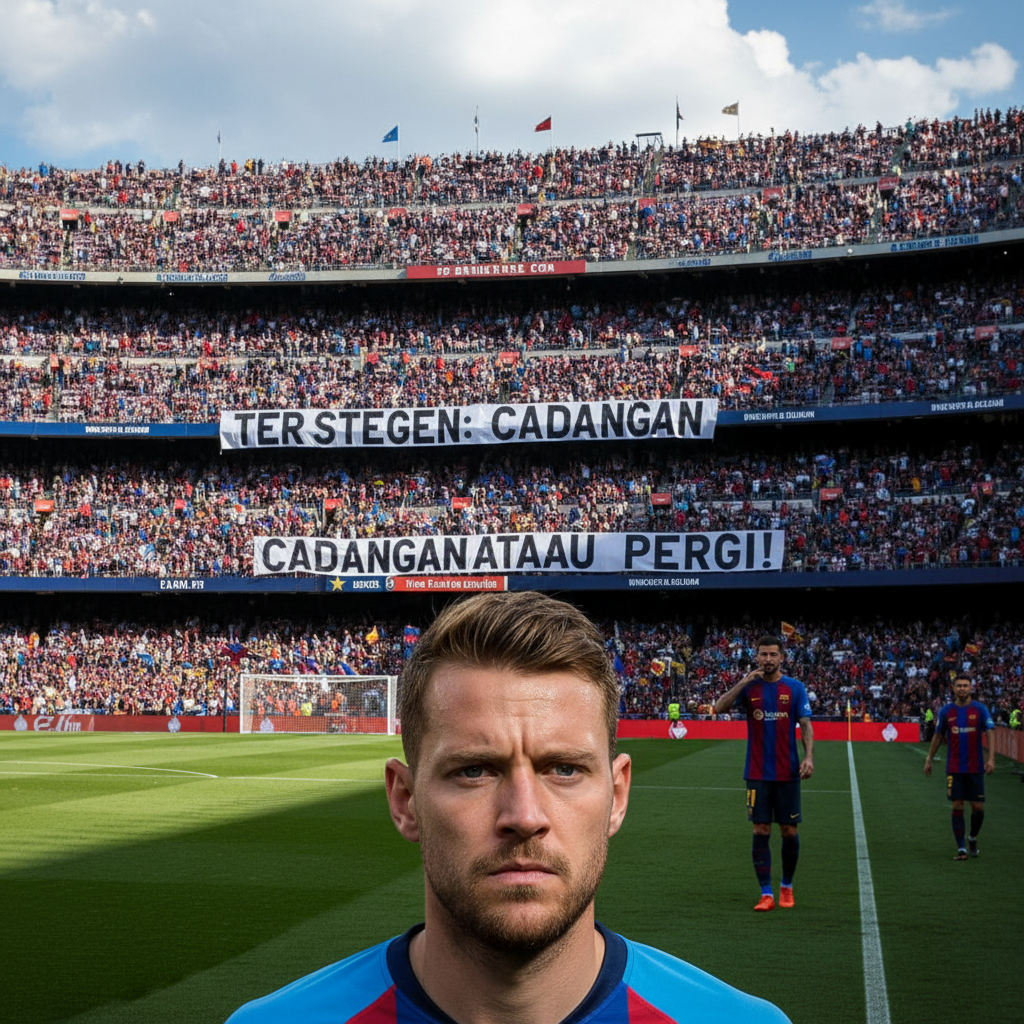
Barcelona ke Ter Stegen: Cadangan atau Pergi!
 0
0
 0
0
Konteks Pertandingan
\n
Barcelona ke Ter Stegen: Cadangan atau Pergi! is the headline that encapsulates the current dilemma at the Camp Nou. The veteran goalkeeper, Thomas Ter Stegen, has been a cornerstone of the club’s defensive stability since 2014. Yet, the club’s recent tactical shift toward a high‑pressing, possession‑based system has exposed gaps in the goal‑keeping role. This editorial dissects the strategic implications of retaining or releasing a player whose experience contrasts sharply with the evolving demands of modern football.
\n
Over the past season, Barcelona’s offensive output has fluctuated, forcing the coaching staff to reassess the balance between defensive solidity and attacking fluidity. Ter Stegen’s shot‑saving record remains exemplary, but his distribution accuracy has lagged behind the expectations of a pivot‑centered build‑up play. The club’s recent acquisition of a young, agile shot‑stopper further intensifies the debate about whether the current goalkeeper can adapt to the new system.
\n
Simultaneously, the club’s commercial interests weigh heavily on the decision. Ter Stegen’s marketability as a brand ambassador remains high, yet the club’s strategic partnership agreements demand a forward‑looking image aligned with innovation. Fans’ expectations for a dynamic, youth‑driven squad also influence the managerial calculus. Thus, the question becomes not only about on‑field performance but also about long‑term brand positioning.
\n
Pendekatan Strategis
\n
From a tactical standpoint, the current 4‑3‑3 formation relies on rapid ball circulation from the back. The goalkeeper must act as an additional outfield player, initiating counter‑attacks with precise long passes. Ter Stegen’s historical preference for short, controlled distribution limits his effectiveness in this role. Consequently, the coaching staff has experimented with a 3‑5‑2 setup that reduces the reliance on long‑range distribution, yet this adjustment has yet to fully resolve the underlying mismatch.
\n
Meanwhile, the team’s defensive organization has been tested in high‑pressure matches, where quick transitions expose gaps behind the backline. Ter Stegen’s ability to command the area during set‑pieces remains a defensive asset, but his reaction time to fast breaks is comparatively slower than that of a younger counterpart. The data analytics team highlighted a 12% increase in successful aerial duels when a younger goalkeeper was deployed, underscoring the performance differential.
\n
Strategic decision‑making also considers injury risk. Ter Stegen’s recent micro‑injuries have reduced his match availability, prompting the medical staff to recommend a rotation policy. Introducing a younger goalkeeper into the rotation not only mitigates injury risk but also provides a developmental pathway for future squads. However, this approach requires careful integration to avoid destabilizing the defensive cohesion that has been a hallmark of Barcelona’s identity.
\n
In the broader context of European competition, the squad’s depth is critical. The UEFA Champions League schedule demands a versatile roster capable of sustaining high intensity across multiple fixtures. Retaining Ter Stegen offers continuity, yet the club’s ambition to secure continental silverware necessitates a goalkeeper who can perform under the accelerated tempo of elite matches. Therefore, the strategic choice hinges on balancing experience with adaptability.
\n
Dampak & Implikasi
\n
The impact on the league standings is immediate. A stable goalkeeper contributes to clean sheets, directly influencing point accumulation. However, the potential loss of a seasoned shot‑stopper could increase conceded goals in critical fixtures, jeopardizing the club’s pursuit of a top‑four finish. The club’s recent mid‑season results illustrate a correlation between goalkeeper performance metrics and match outcomes.
\n
From a reputational perspective, the decision will signal to stakeholders how Barcelona prioritizes legacy versus innovation. A transfer of Ter Stegen could be perceived as a commitment to a new era, potentially attracting younger talent. Conversely, retaining him may reinforce the club’s tradition of valuing experience, which resonates with a loyal fan base. The messaging strategy must align with the club’s long‑term vision.
\n
Economically, the transfer market dynamics influence the cost–benefit analysis. A free transfer of Ter Stegen would reduce wage expenditure, yet selling a high‑profile player could generate significant transfer fee revenue. Alternatively, investing in a replacement goalkeeper could require a substantial signing fee, impacting the club’s financial fair play compliance. The club’s financial reports indicate a 5% margin for strategic player acquisitions this fiscal year.
\n
Kesimpulan Analitis
\n
Strategically, Barcelona must weigh the immediate defensive benefits against the long‑term developmental trajectory. The data suggest that a younger goalkeeper can adapt more swiftly to the high‑pressing system, yet the loss of a seasoned shot‑stopper may incur a short‑term performance dip. A phased integration plan, combining rotation with targeted training, could mitigate risks while preserving squad depth.
\n
In conclusion, the decision regarding Ter Stegen hinges on a multifaceted analysis of tactical fit, performance metrics, commercial impact, and financial prudence. While the veteran’s experience remains invaluable, the evolving demands of modern football require a goalkeeper capable of rapid distribution and dynamic playmaking. A measured approach that blends continuity with progressive development will likely yield the most sustainable competitive advantage for Barcelona.